📄 Digital book in PDF · read it on your phone or print it
Defect categories, brakes, brake efficiency, steering, tyres, windscreen zone A, headlamp aim, corrosion and emissions. Every topic has its own page: the drawing first, then what you need to remember. 65 illustrated pages.
🔒 Secure checkout · PDF by email · 30-day guarantee
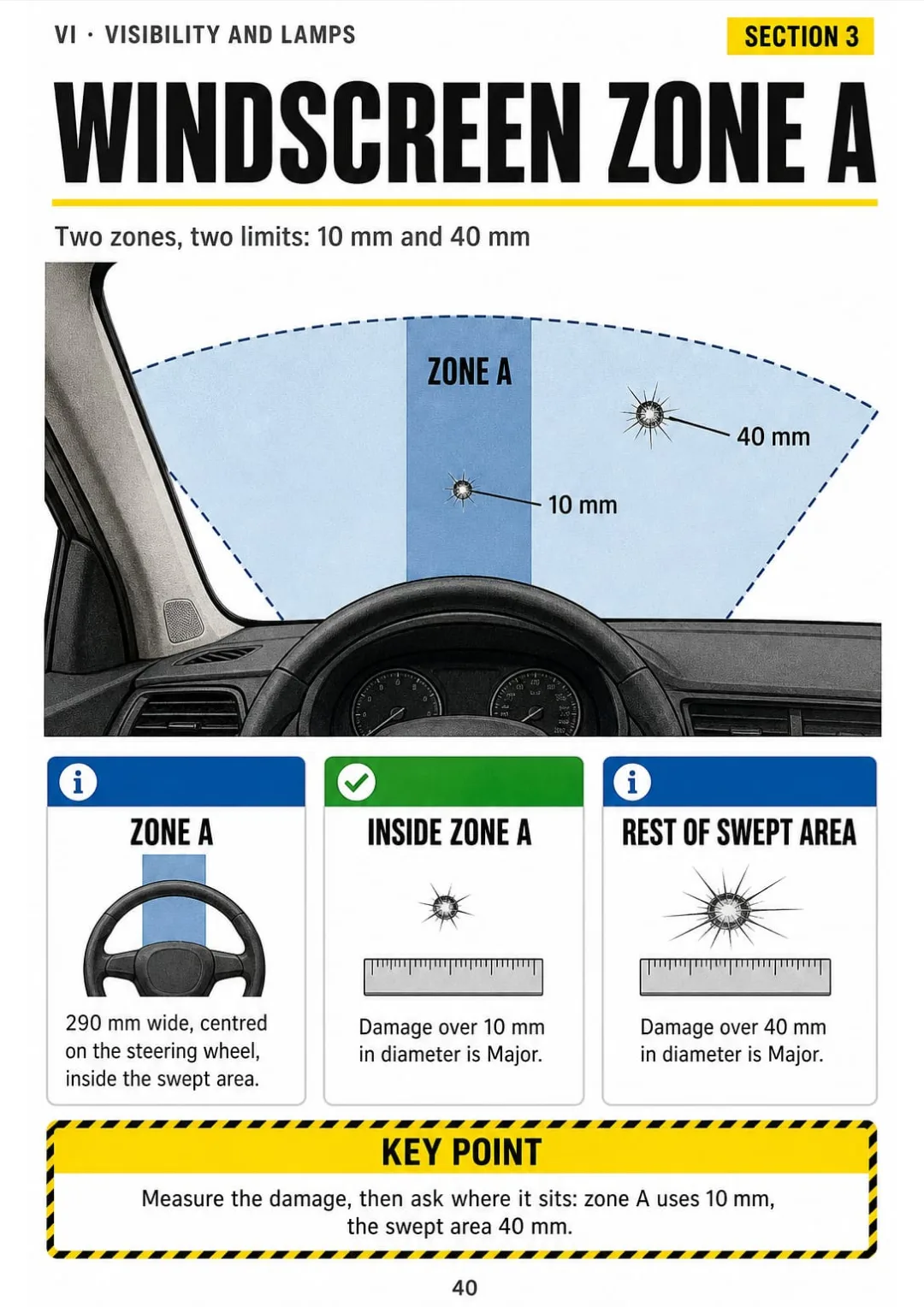
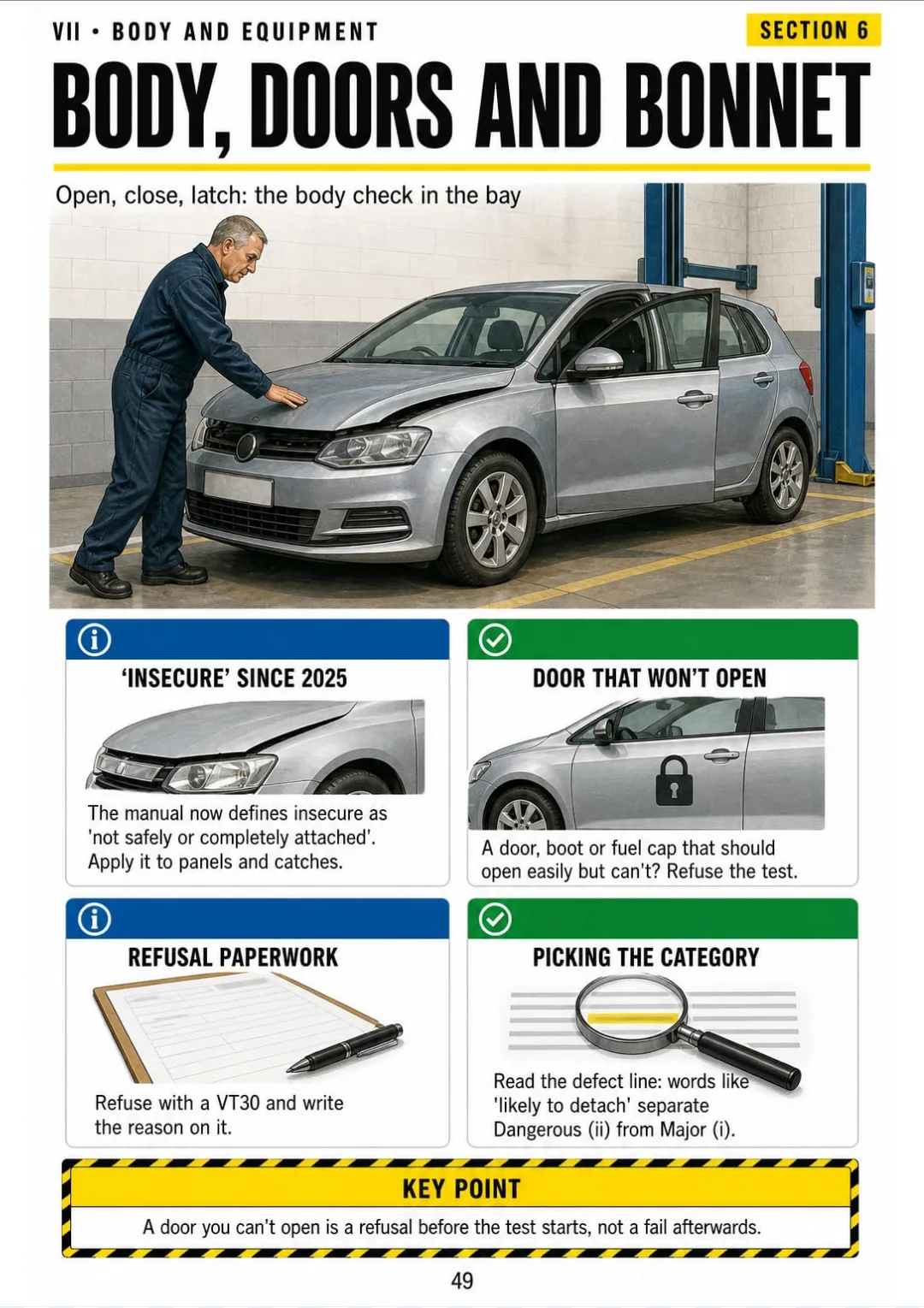
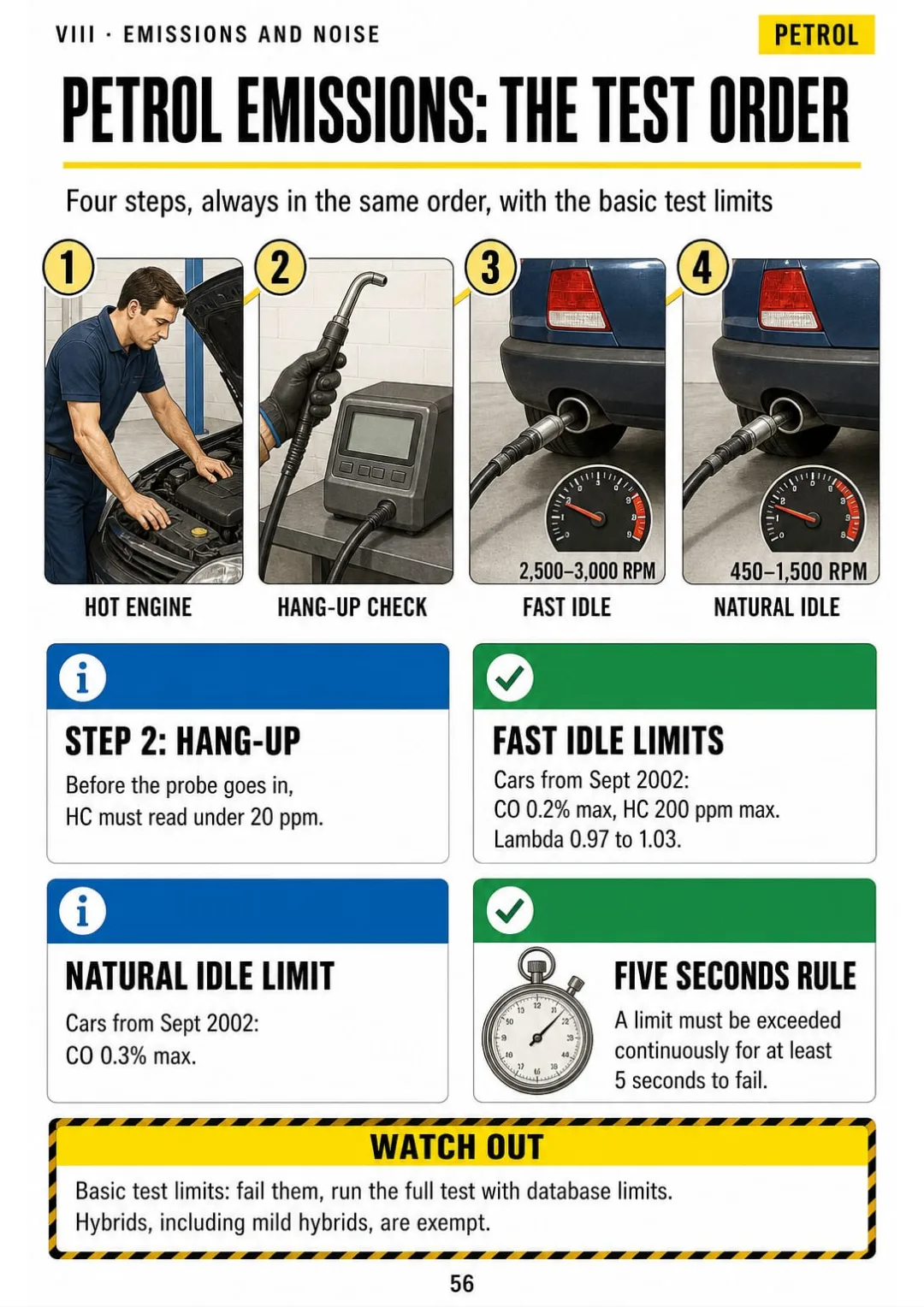
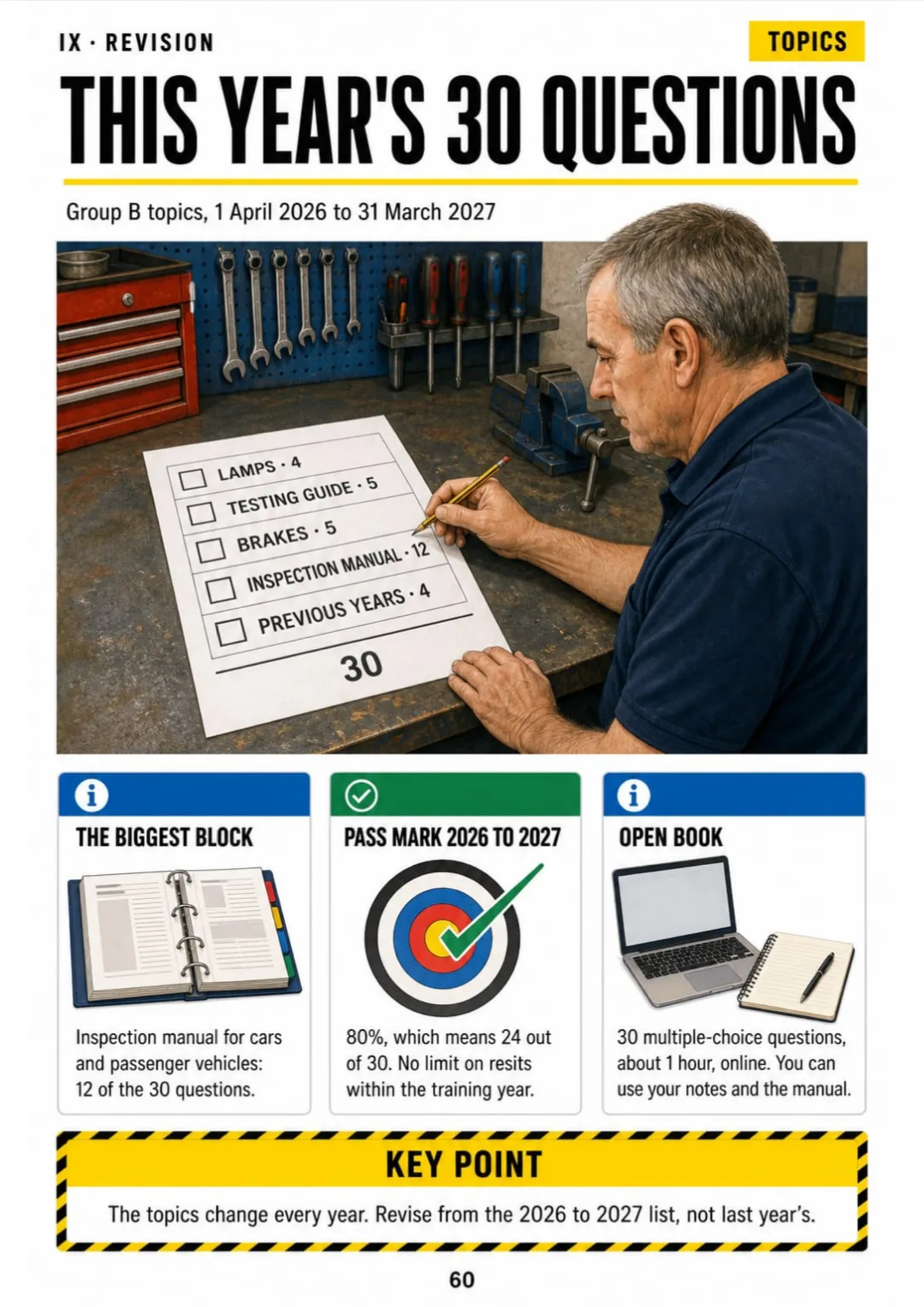
Every page has one big drawing and a box with the figures, limits and categories you need to know:


Swipe to see more →
These are real pages from the book. The table of contents is the full one: 9 parts and 61 topics.
You're sitting the annual assessment and a question asks for the minimum service brake efficiency of a car first used in 2012. Four options, all close.
You've read roller brake tester results for years. But the manual sets the figures out in paragraphs and tables, by vehicle category and date of first use, and after a full day in the workshop the numbers blur into one another.

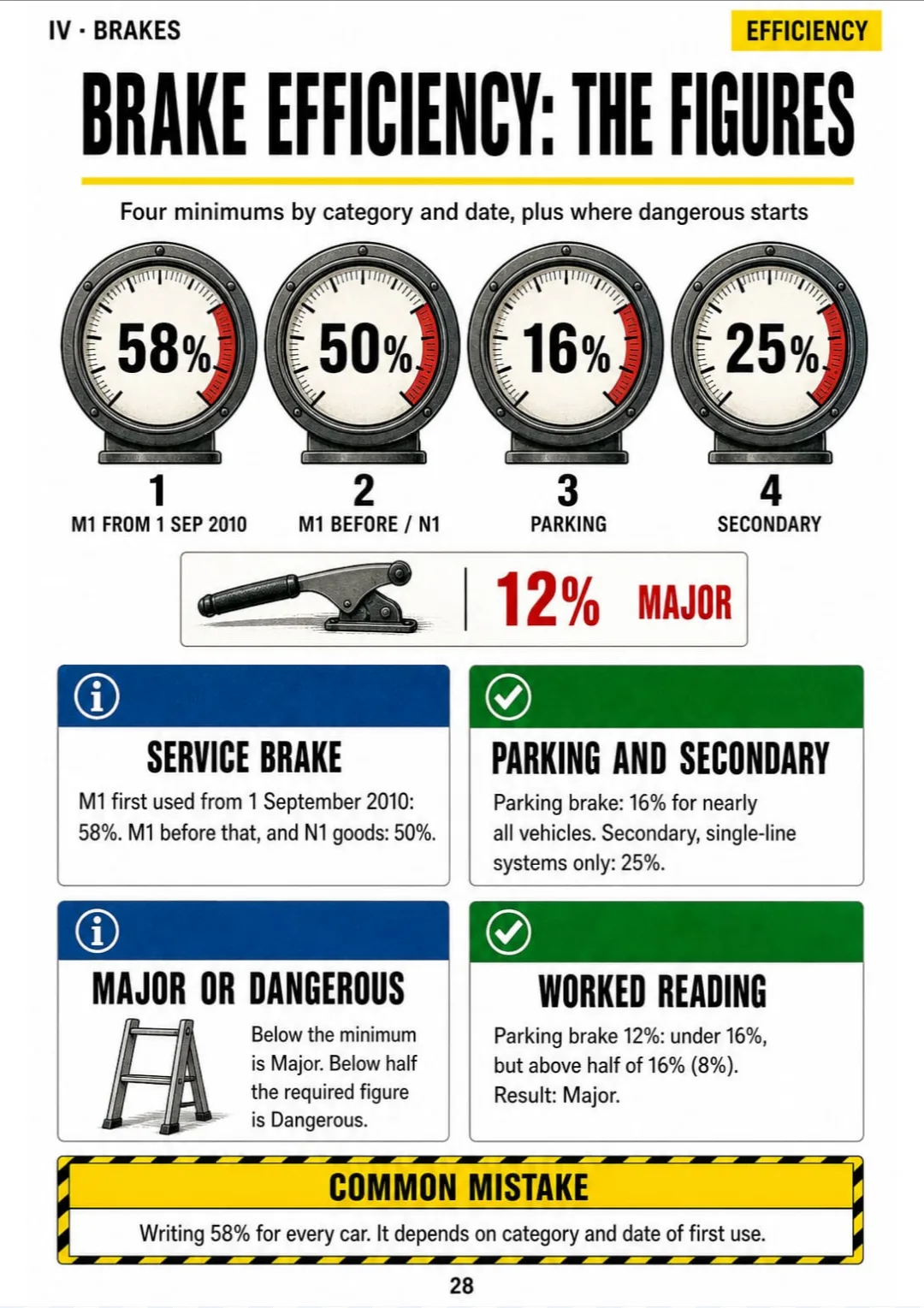
In the book, brake efficiency is one page: 58% for M1 first used from September 2010, 50% for earlier M1 and for N1, 16% parking, 25% secondary. Each figure sits in its own box, next to the vehicle it applies to.
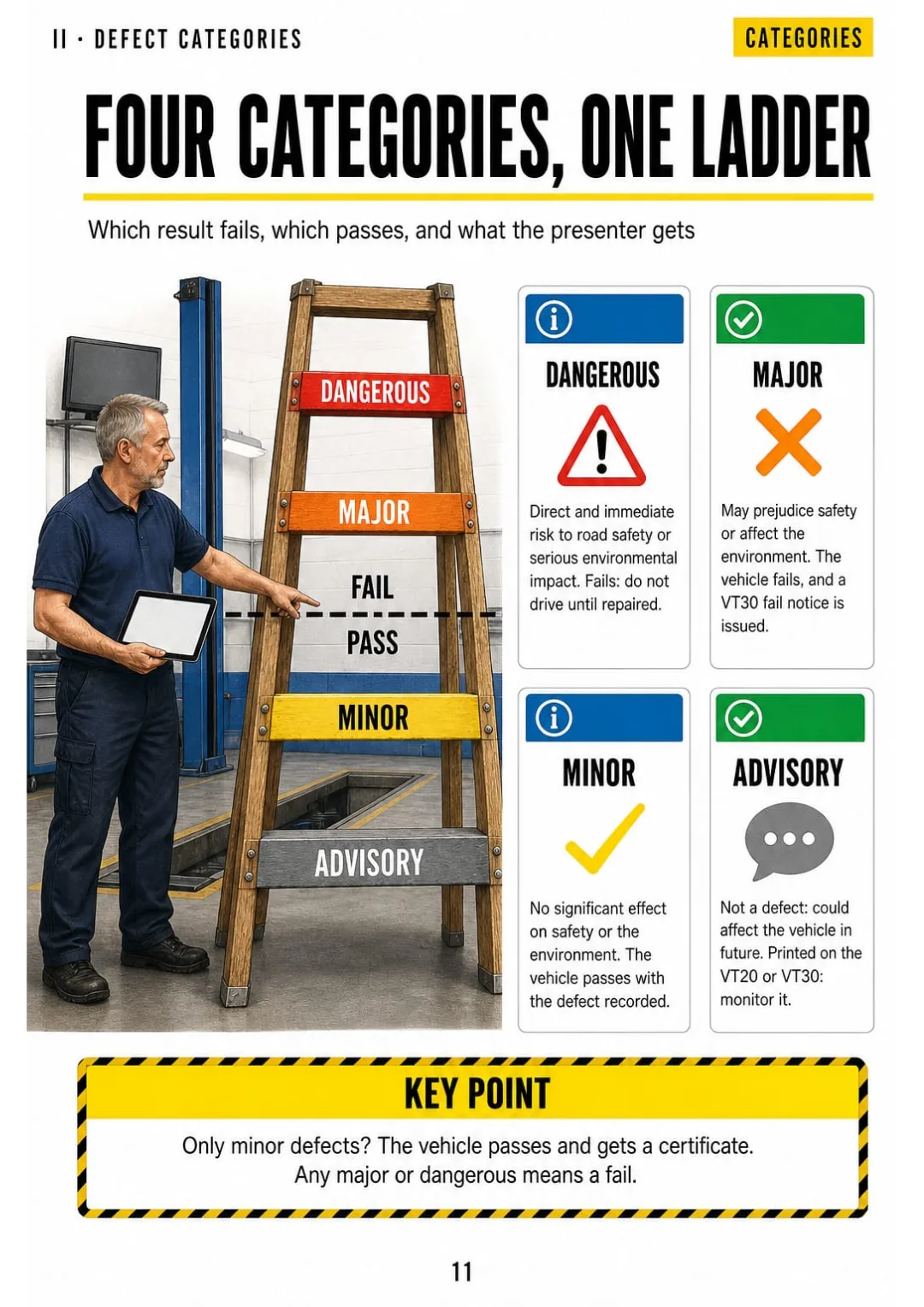
The same goes for discs, drums and pads, windscreen zone A, corrosion within 30 cm, the petrol emissions test and the four defect categories: each one has its own page.
You see the figure, you know which vehicle it belongs to, and you answer without going back to the manual.

Your role and the yearly rules, defect categories, identification, brakes, steering, suspension, wheels and tyres, visibility and lamps, body and structure, emissions and noise, and revision for the assessment: 65 pages, all illustrated.
Think of it this way:
A car is on the ramp with worn front pads, or an assessment question describes them in words you never use in the bay. You need the category, and you need it now.
You open the discs, drums and pads page and see the pad drawn down to its wear indicator: at the indicator, major; under 1.5 mm, dangerous; the wear lamp alone, pass and advise.

The same with windscreen zone A, the roller brake tester, corrosion within 30 cm, headlamp aim and the petrol emissions test: each one on its own page, in the same order.
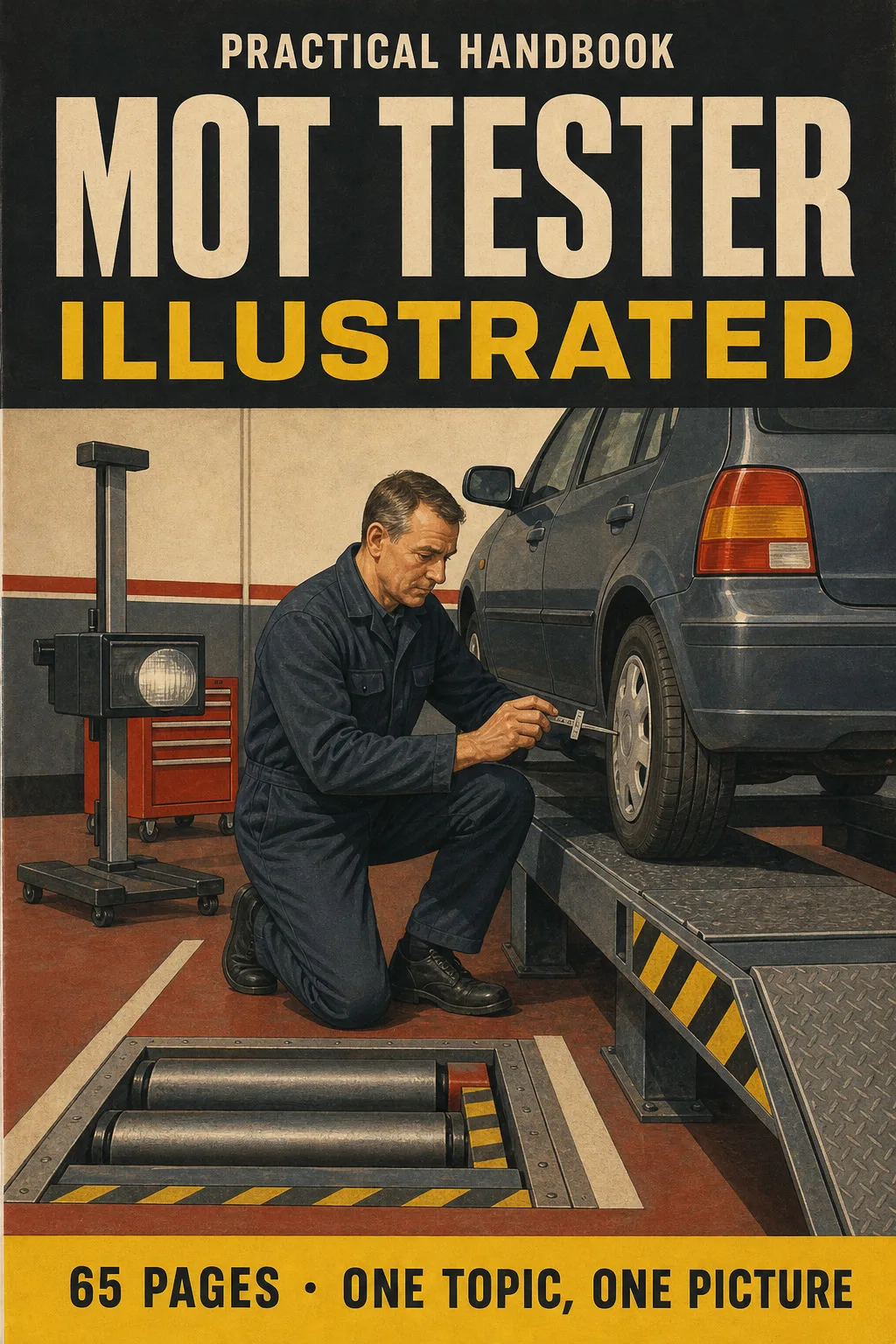
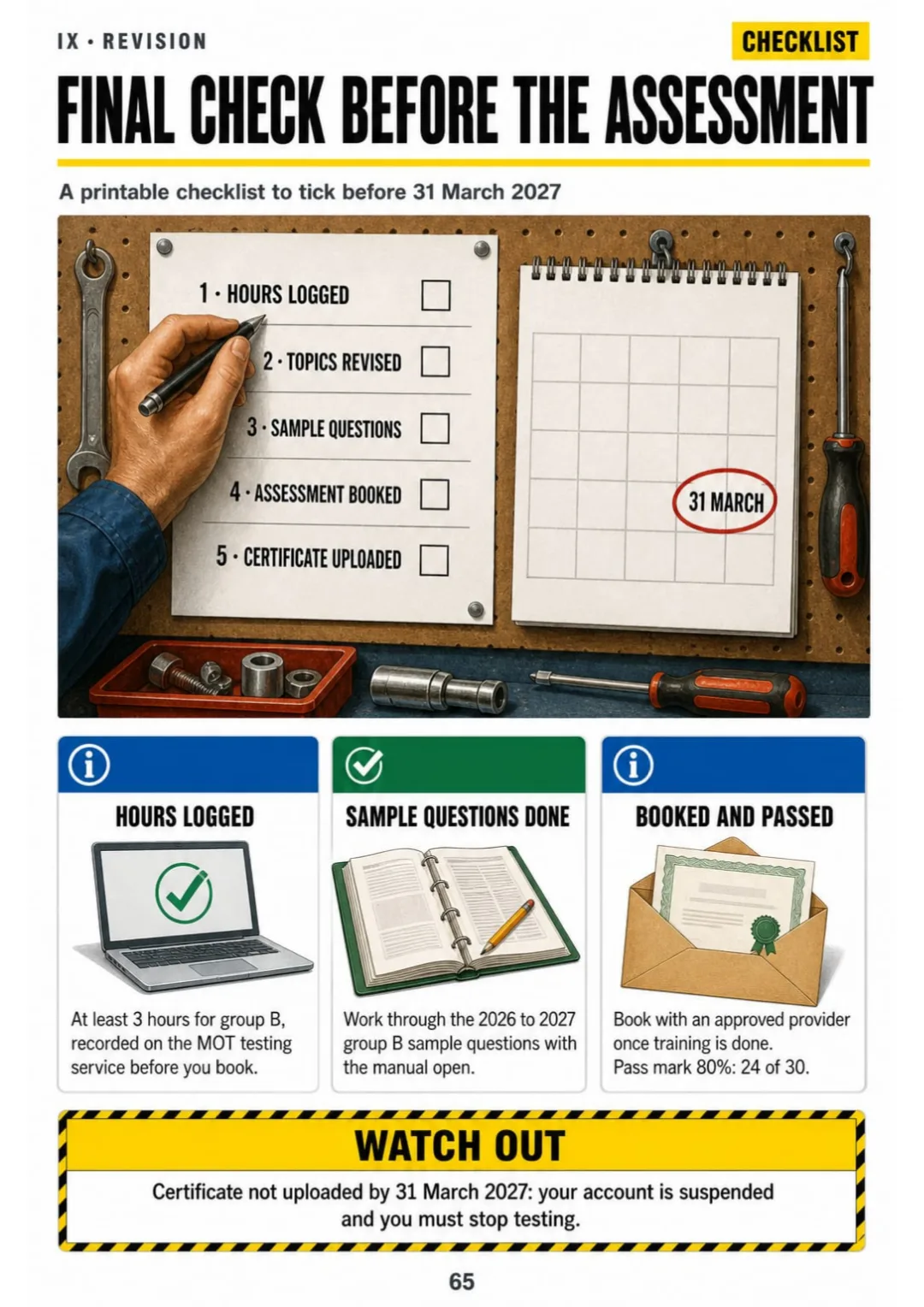
MOT Tester Illustrated is 9 parts and 61 topics, all drawn, and at the end a revision part with this year's topics, the most frequent mix-ups and a final check before the assessment.
What you see drawn, you don't have to memorize.
The training year, the hours that count, how the annual assessment works, the vehicle classes, the manual's sections and the four steps for every item: find it, inspect it, categorise it, record it.
The four categories as one ladder, dangerous versus major, minor versus advisory, PRS, several defects on one item and the words the assessment uses differently.
VIN checks, registration plates, vehicles you can refuse to test and why the date of first use matters.
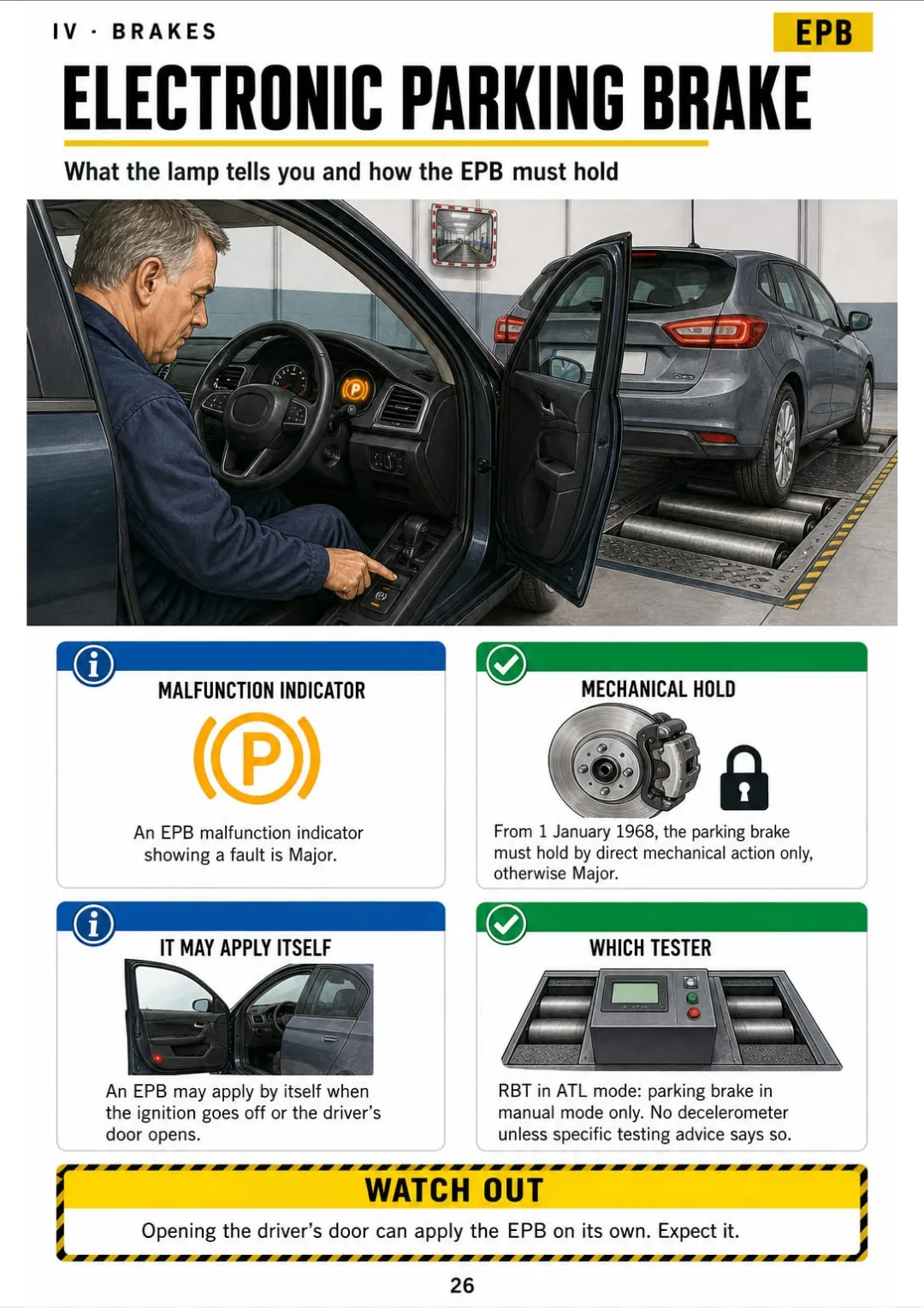
The brake walk-round, discs, drums and pads, fluid and warning lamps, ABS, EBS, the electronic parking brake, the roller brake tester, efficiency figures and imbalance.
Steering wheel, column, joints and rack, power steering, suspension, shock absorbers, wheels and hubs, tread depth, tyre condition and the TPMS lamp.
Windscreen zone A, wipers and mirrors, headlamps and their aim, all the other lamps, battery, wiring, horn, HID and LED.
Corrosion within 30 cm, body and doors, seats and belts, SRS lamp, fuel system, towbars, speedometer, ESC and steering lock.
Exhaust condition, the petrol emissions test in order, the diesel smoke test, DPF and visible smoke, noise and fluid leaks.
This year's topics on one page, a ten-minute routine, the most frequent mix-ups, finding any item fast, recording without errors and a final check.
At the end of the book: This year's topics on one page, the most frequent categorisation mix-ups and a final check before the assessment.
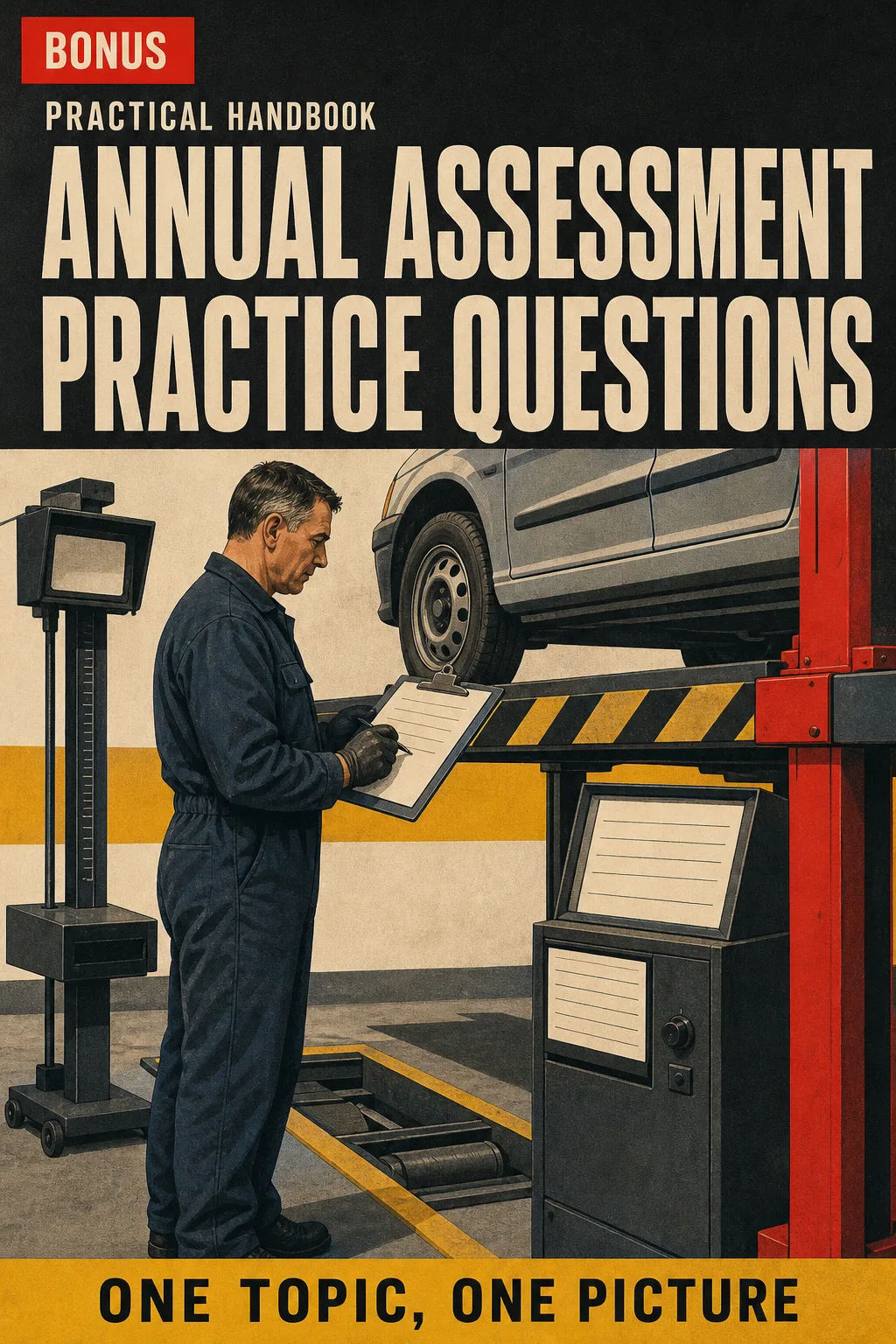
Multiple-choice questions in the style of the annual assessment, with the answer explained and the manual section to look up, so you can test yourself before you sit it.

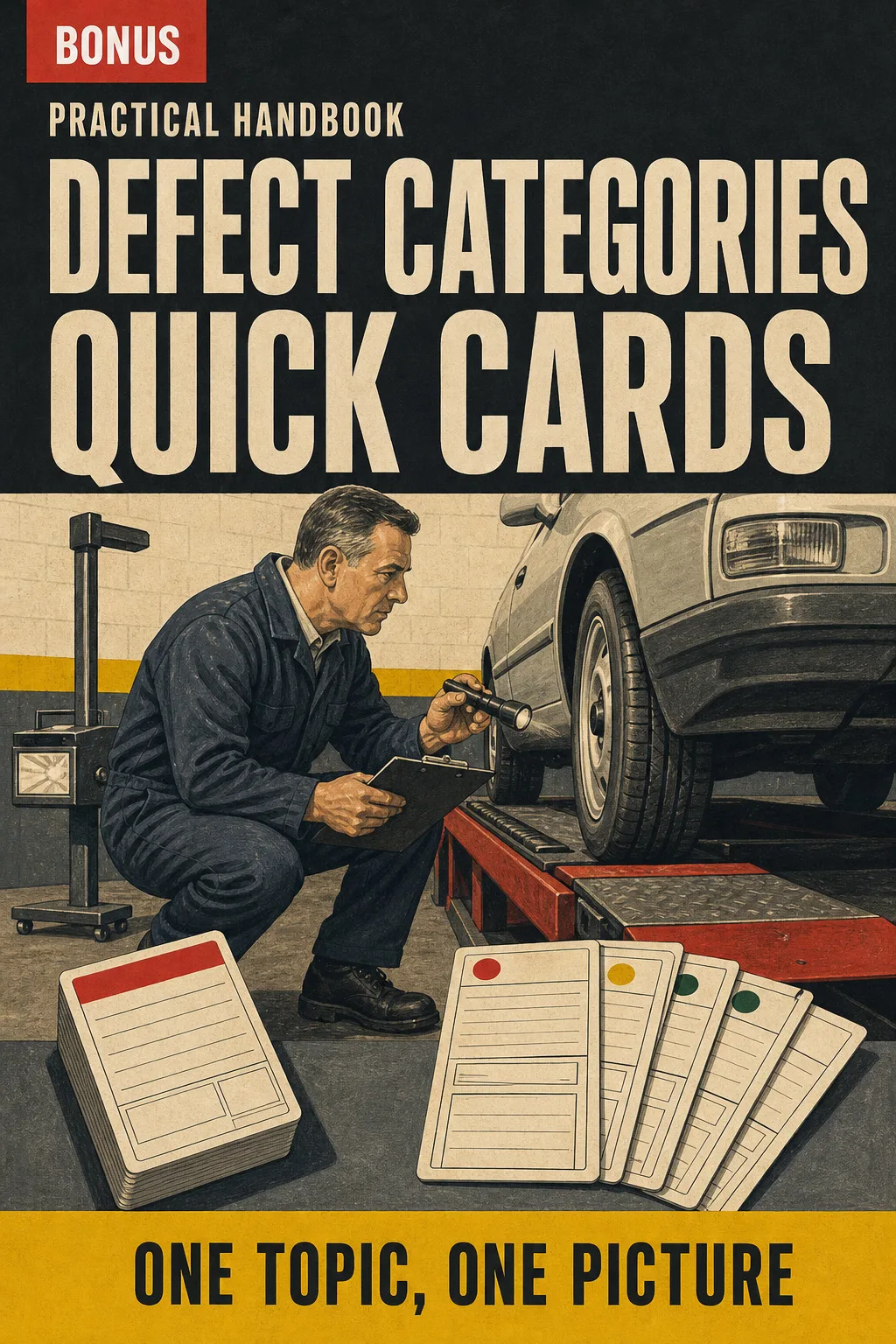
One card per system with the most frequent dangerous, major, minor and advisory examples, to revise in ten minutes on a tea break.
📄 This is a digital PDF book sent to your email: nothing is printed or shipped.
PDF by email: We email you MOT Tester Illustrated as a PDF, together with the two free books. It's a single payment: no installments, no extra charges.
Each inspection item on its own page, drawn, so you revise in short sessions after work and it stays.
This year's topics on one page and the most frequent categorisation mix-ups, so you know exactly what to go over first.
A printed copy in the test bay to check a limit or a category in seconds, with the route to the item in the manual.
📄 This is a digital PDF book sent to your email: nothing is printed or shipped.
Try MOT Tester Illustrated for 30 days, bonus books included.
We refund everything if the file won't open, if the book isn't what you see here, if you were charged twice or if the email doesn't arrive. Just email us.
You pay once. No subscriptions.
Yes. It's written for working testers, not beginners: no theory you already know, just each item drawn with its limits and category. It follows the inspection manual for cars and passenger vehicles (classes 3, 4, 5 and 7), with class 4 as the main thread. Where a figure changes by class or vehicle category, the box says which one it applies to, so class 7 testers can see their figures too.
From the GOV.UK guidance for MOT testers: the MOT inspection manual for cars and passenger vehicles as currently published, the MOT testing guide, and the annual training and assessment guidance for the 2026 to 2027 training year, which ends on 31 March. Everything is paraphrased and drawn, never copied.
No. It's an independent revision book, not affiliated with or endorsed by the DVSA.
No, and it doesn't come with a certificate. You still complete your annual training, keep your training record as DVSA asks, and take the annual assessment through the official route. This book helps you revise for it.
No. They're written for this book, in the style of the assessment, with the answer explained and the manual section to look up.
The book and the 2 free books arrive as PDFs by email, at the address you enter when you pay.
No. It's a one-off payment.
Yes. The PDF prints well at home or in the workshop, so you can keep a copy in the test bay.
You have 30 days. We refund everything if the file won't open, if the book isn't what you see on this page, if you were charged twice or if the email doesn't arrive: just email us.
No more rereading the manual with nothing sticking.
Brake efficiency figures: you see them drawn, and they stick.
You go into the assessment knowing where every item is.
Drawings make studying faster.
The book is right below.
One-time payment: US$ 27 · Guarantee: 30 days · PDF by email
YES, I WANT MOT TESTER ILLUSTRATED FOR US$ 27📄 This is a digital PDF book sent to your email: nothing is printed or shipped.